


![]() |
|
|
|
![]() |
|||
| Bight and
Loop Like an earthworm, a rope has two indistinguishable ends. Everything in between is the "standing part." The simplest maneuver is a change of direction, called a Bight. A cross over or under is called a Loop. The end left hanging is called the "bitter end." |
Figure -Of-
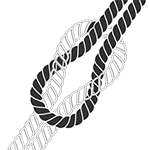
Eight Less complicated than the knot you put in your shoelaces, the Figure-Of-Eight is an ideal basic knot for use at the end of a line to prevent a sheet or line from slipping through a block. Make an underhand loop, then bring the free end over the standing part and bring it under and through the loop. |
Bowline For a simple running loop, the Bowline is the sailor's best friend. Begin with a small overhand loop, make a larger loop and bring the free end through the first loop. Now form a bight by bringing the free end under and over the standing part, then back through the loop. This won't slip or snarl under strain, yet will untie easily with one tug on the bight. |
Belaying Endlessly winding a rope around a cleat is not Belaying. Loop the line around the base, under the arms of the cleat, then bring it up and over diagonally, around and under one arm, then over, around and under the other, in a continuous figure eight, securing the bitter end by tucking it under the last crossover. |
![]() |
|||
| Fisherman's
Bend or Anchor Bend The two loops that swivel freely make the Anchor Bend perfect for making fast a line to an anchor, buoy or spar. Take two turns through the ring, followed by an underhand loop, then thread the bitter end through the turns and pull tight. You should give the bitter end an extra hitch around the standing part for greater strength. |
Tug Boat
Hitch The Tug Boat Hitch is ideal for heavy towing, yet can be released under great strain when necessary. Take one or two turns around the towing post, cross the bight under, then drop the bight over the top. Now loop the bight back around the standing part, drop the bight over the top with a half twist, and pull taut. |
Single Sheet
Bend The Sheet Bend, used to tie two ropes together, is at its best when things are complicated by ropes of unequal size. Form a bight in the larger line. Thread the smaller line's bitter end through the bight, around it, back through the under itself, and out over on the same side as the large line's bitter end. |
Double Sheet
Bend When the strain on the two ropes you are joining is particularly great, tie the Single Sheet Bend, as above, leaving enough length in the small line's bitter end for another loop around, under itself inside the bight, and out over again. To prevent slipping and jamming, always make sure that both bitter ends are on the same side of the knot. |
|
| ||||||||||||||||||||||||||
|
Round Turn and Two Half Hitches Formerly known as a Rolling Hitch Is especially useful when there's a strain on the line, since you can tie it with one hand while holding the line taut. Take two turns through the ring or around the post, then finish up with a clove hitch over the standing part. Keep this one set snug. |
Clove Hitch When a line has to be made fast to a pile or spar quickly, the Clove Hitch is the simple, speedy answer. A simple loop around the pile, followed by a second, with the free end crossed under and pulled tight, results in a hitch that gets even tighter as tensions increases on the standing part. |
||||||||||||||||||||||||||
Courtesy of 
![]()
262 SW 33rd. Street
Fort Lauderdale, FL 33315
(954) 525-6575 PH.
(954) 525-5887 FAX